

Set Pieces Only: Quantifying the Value of James Ward-Prowse
A fun thought exercise on one of the game's most unique players


A core thesis of the modern soccer analytics intelligentsia is that clubs significantly undervalue set pieces. Set pieces — penalties, free kicks, corner kicks — essentially amount to free, entirely incremental goals at no expense to a club’s open-play abilities. Yet, many clubs only practice set pieces for under an hour per week. Tottenham set piece coach Gianni Vio entitled his UEFA Pro License thesis, “Set Pieces: the 15-goal striker.” Following Matthew Benham’s purchase of Denmark’s Midtjylland, the club famously went all in on set piece maximization, won their first ever Danish title on the back of it, have become Champions League regulars, and basically broke the sport in Denmark. Benham also owns Brentford, who last season finished comfortably in the top half of the table amid particularly strong set-piece performance across all metrics.
On Saturday, James Ward-Prowse rang in his debut at West Ham United with two assists (one from a corner, one in open play) in a big win over Chelsea. Ward-Prowse joined West Ham on a £30M fee from Southampton (who are effectively led by Rasmus Ankersen, who previously effectively led the rises of Midtjylland and Brentford) and is best known as England’s set piece king. He has scored 17 free kick goals in the Premier League, one behind David Beckham and five ahead of third-placed Thierry Henry in the league’s history.
Ward-Prowse is theoretically the skeleton key to this untapped, massive chamber of value. Yet, he profiles as somewhere around mediocre at every other element of soccer. Our key question today is: How valuable is a player of Ward-Prowse’s unique profile?
Ward-Prowse’s profile is akin to an NBA player who can reliably sink threes but is a passenger in all other contexts or an MLB player who can mash home runs but cannot do anything else. To what extent does the clearly positive value make up for all the value lost elsewhere? Ward-Prowse’s counterparts in the NBA (e.g. Duncan Robinson) and MLB (e.g. Joey Gallo) generally seem to support net positive value — but it’s not clear. As soon as the ball stops going in whatever goal one’s sport is pursuing, these players’ values dry up quite quickly. Robinson and Gallo have accordingly been in and out of their teams’ lineups throughout their careers, yet Ward-Prowse plays almost literally every minute for his teams. Of course, the value wagers take on different weights across different sports, but one has to wonder if Premier League clubs are miscalibrating the value of Ward-Prowse.
The best way to quantifying the value of any player, especially non-forwards, would be by using some form of an expected possession value model or expected threat model. Such models calculate the incremental value of every action taken by every player and theoretically build toward a holistic defined value. American Soccer Analysis does this effectively for American leagues. Such models of course have their own high degrees of uncertainty these days and would require a post full of qualifiers, but they measure midfielder value better than anything the public is aware of. However, we civilians possess nothing close to the data needed to generate such outputs nor the outputs themselves for Premier League players. As a result, I will take another approach to attempt to quantify Ward-Prowse’s value — but more importantly provide discussion along the way.
I will start by calculating the value that Ward-Prowse has provided across the four key areas of set pieces: penalties, direct free kicks, assisted free kicks, and corner kicks. I will calculate value using goals as the main metric before discussing how that maps to points and financial value. I also will get into a much-less-quantitative assessment of all the other areas of his game to develop a holistic view of his value, concluding with discussion on how clubs should think about players like Ward-Prowse given the analysis.
Ward-Prowse’s Positive Value: Set Pieces
Key Notes on the Analysis
For these calculations, I am using Ward-Prowse’s statistics from the four seasons beginning with 2019-20 and ending with 2022-23. These are the four seasons during which Ward-Prowse has been a Premier League regular. A regular he indeed was: the midfielder played 98% of available league minutes across those four seasons, including two seasons of a full 3,420 minutes. This is more rare than most fans realize, with James Tarkowski the only outfield player to accomplish this feat last season.
For baseline, league-wide statistics, I am using 2022-23 numbers unless stated otherwise. I would match the samples directly if the data gathering process were not so manual and tedious, and one season across all teams gives us robust enough samples (8,857 free kicks, 3,671 corners, and 72 penalties) to use as baselines. I stripped Southampton out of these numbers so that the comparison set does not include Ward-Prowse himself. The number of set pieces per team has surprisingly low correlation to a team’s point totals. Given we seek to mostly assess Ward-Prowse’s value in a vacuum and that in practice he joined the club coming off an 11th-best-xGD season, we can reliably take league-wide averages of baselines for number of set pieces to quantify total value.
All “expected” numbers (e.g. xG/xA) come from Understat, as they offer data segmented across situations. All other numbers come from FBRef/Opta, with care taken to ensure no mismatching of data sets.
A key point around quantifying this value: I will do so using what has happened across these four seasons, which is different from what we can expect to happen, which is the more important question. Ward-Prowse’s set piece performance has been so impressive that it almost certainly involves him running hot above a sustainable performance level to some extent. The upshot is these quantifications will quite likely give him more value credit than a club like West Ham should expect to extract going forward, never mind considerations that at 28 years old, Ward-Prowse is theoretically on the decline phase of his career. However, there is not a great way to quantitatively scale this value down, so I will choose to give him this historical credit, with plenty of commentary about the extent to which the values are accurate. Ultimately, we are working with high levels of uncertainty, but it is still a useful exercise.
Penalties
Let’s start with the easiest area to quantify, since penalties are the single most closed-system event in the sport. In the sampled time period, Ward-Prowse scored 10 penalties on 15 attempts, which equates to 11.42 xG. This means he has actually provided negative value to Southampton on penalties, with 1.42 goals lost. That corresponds to -0.09 value per penalty. As we want to project value forward to the extent that we can, we must assume the number of penalties won is exogenous to Ward-Prowse’s value and take the average number of penalties per team per season of 3.79. This gets us to our value of Ward-Prowse’s penalties per season of -0.36 goals.
Yet, the safest assumption to make is that Ward-Prowse’s underperformance on penalties is just noise and that going forward, he would convert the expected 76% of his penalties. However, I do not think that in good faith we can write off his underperformance on penalties as noise while also giving him full credit for his overperformance in other areas. For the sake of logical consistency, let’s assume his penalty record predicts his future performance.
Penalty Value per Season: -0.36 Goals
Direct Free Kicks
The data confirm that this is where Ward-Prowse really shines. Since free kicks are the one non-penalty situation in which xG is due entirely to exogenous factors, the value calculation is also relatively simple here: how many more goals did Ward-Prowse score from free kicks more than expected?
He has scored 13 goals on 84 free kick shot attempts and just 5.10 xG. That is a colossal overperformance of 7.90 goals, good for 0.09 per shot! With the average team earning 14.95 shot-leading free kicks per season, if Ward-Prowse can sustain his free kick conversion rate, he is good for an incremental 1.41 goals per season versus the average player.
This might be the single most important and conclusive finding of this otherwise uncertain analysis: Despite Ward-Prowse massively overperforming on free kick conversion, he has only added 1.41 goals per season to an average team. In my poking around on Ward-Prowse analyses in preparing for this, I noticed many fans saying he’d give his club 5+ free kick goals per season — which is simply not true.
The reasons this is surprising are twofold: (1) Clubs are only winning 15 shot-leading free kicks per season, which is lower than fans may expect. There is little indication that Ward-Prowse made more free kick situations shot-leading situations than players at other teams did. Even a generous scaling up of direct free kick opportunities would see Ward-Prowse’s value fail to exceed 2 goals per season. (2) Other players score free kicks too! Any free kick goal is not incremental — only performance above xG is.
Direct Free Kick Value per Season: 1.41 Goals
Assisted Free Kicks
I am sorry to report this is where things get difficult. Ward-Prowse has 6.29 xA — here we can and should use xA because that is the extent of the action that is within his abilities — on 468 passed free kicks, 50 of them leading to shots. This corresponds to a value of 0.013 xA per free kick, well above the league average of 0.008 per free kick. However, we cannot derive incremental value from these numbers for several reasons.
Ward-Prowse has a free kick “mix” skew relative to the entire set of free kicks. The total denominator includes all free kicks taken anywhere on the field, with a very large share of them being in non-chance-creating locations. Yet, Ward-Prowse’s denominator only includes the free kicks he takes, which are unlikely to include most of the non-threatening free kicks, such as those taken in the defensive or middle thirds. We also cannot use xA per shot-generating free kick, since that would strip out any potential value Ward-Prowse provides by creating more shot-generating free kicks. To get a better quantification, we would want to look at something like free kicks taken in the final third, but unfortunately no such data exists publicly.
At a higher level, Southampton generated 0.0075 xG per passed free kick last season, narrowly less than the league average of 0.0081. This still says nothing about mix skew — do a greater share of Southampton’s free kicks come outside the attacking third than its competitors? — but the concern is less significant at a team level.
Here is what we can say: (1) There is no holistic evidence that Southampton have seen particularly great performance on assisted free kicks. (2) Ward-Prowse has generated 1.57 xG per season on assisted free kicks, so the likelihood that there is significant, if any, incremental value provided in this area is low. Although there is a lot of uncertainty in calling this a wash, the magnitude of that uncertainty does not appear to be that high.
Assisted Free Kick Value per Season: ———— (??)
Corner Kicks
There is a tricky data situation here that I will spare the boring details on, but basically, the Understat data gives Ward-Prowse 9.37 xA on corners over the four seasons but gives Southampton 29.91 xG on corners over the same stretch, despite Ward-Prowse taking 91% of their corners. My inference is the team xG does not need to come from the first touch after the corner is taken but instead in what is broadly considered the corner kick phase of play. (Note that this might be an issue with the assisted free kicks data as well, though the Southampton team xG is much less significantly higher than Ward-Prowse’s xA in that time.) This means that if we calculate everything through using Ward-Prowse’s xA numbers on corners, we get an unrealistically low underperformance versus league team-level averages. To account for this, I will use Southampton team data and safely give Ward-Prowse the credit.
Southampton generated 0.038 xG per corner kick (29.91 xG on 777 corners), 0.007 below league average in that time. At 193 corners per team per season, that would put Ward-Prowse/Southampton’s corner kick value at -1.44 goals per season. The issue is this is not truly a Ward-Prowse stat, since corner kick conversion value necessitates a key action from at least one teammate. We can fairly assume that Ward-Prowse’s teammates suffer from a talent disadvantage versus their opponents (and perhaps also a coaching disadvantage), meaning his corner kicks generate less xG value than they may deserve if we consider his actions in isolation.
In the absence of having a better number, I will tentatively use the -1.44 here. However, as with other above calculations, the more important takeaway is the lack of evidence that Southampton have received outsized value from Ward-Prowse delivering corner kicks.
Corner Kick Value per Season: -1.44 Goals
Tying Together Total Set Piece Value
In summary, I have calculated the following values per season by set piece type:
Penalties: -0.36 Goals
Direct Free Kicks: 1.41 Goals
Assisted Free Kicks: ———— (??)
Corner Kicks: -1.44 Goals
Total: -0.39 Goals
…yikes. The area we expected to find significant positive value for Ward-Prowse has found him to be a negative player. This indicates that either our assumptions about the value he brings are wrong or the data/calculations do a poor job of capturing said value. Of course, the answer is likely a combination of both.
I most fear that the assisted free kick and corner kick data — which currently indicate minimal value from Ward-Prowse — miss some key value points, problematically sandbagging the numbers. A more generous version of the calculations could give us something like this: Let’s call his penalty performance unlucky and give him a 0 there. Let’s say his 21 direct free kicks per season (versus a league average of 15) is the better number, bringing his value there up to 1.98. Let’s say the uncertain free kicks number is missing out on positive value and the corner kicks number is harsh. We’re looking at around 4 goals per season of value at best, but more realistically somewhere around 2 goals in a generously modeled scenario.
That’s still lower than I would bet most fans and analysts have in their heads before diving into the numbers. My takeaway is that even though set pieces are undoubtedly important and undervalued, the value provided by a better set piece deliverer is not very high on his own. (I’ll cover toward the end of this post where more value may be derived.) Additionally, our perception of the incremental value of specifically James Ward-Prowse’s set pieces is likely higher than the actual value provided, even if his direct free kick record is legitimately very impressive.
The Value of Everything Else
Loyal readers already know this is going the way of the goalkeeper piece. Quantification on everything else is basically impossible, but let’s look at the numbers and discuss. Here are the best snapshots we have available, the data on the left coming from Smarterscout (via The Athletic) using 2021-22 numbers (the most recent publicly available), with the right coming from FBRef/Opta using numbers from the last 365 days:
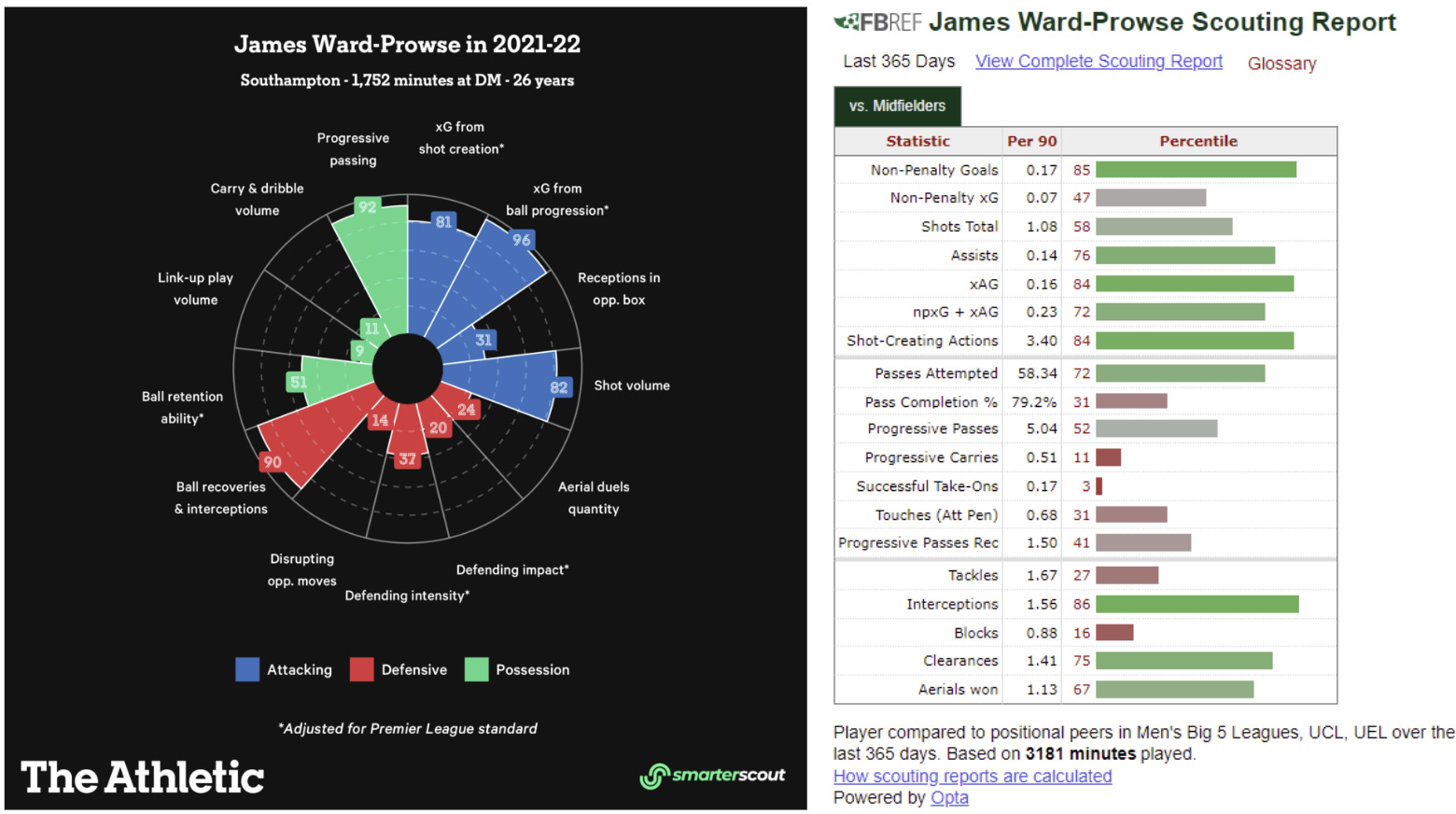
At a glance, that looks pretty good for a low/mid-table player — but these numbers include his set piece dominion. The set pieces especially juice his progressive passing, shot-creating actions, and xAG (functionally the same as xA used above). The Smarterscout “xG from ___” numbers are not sufficiently well-defined to say much about. Mentally stripping out the set pieces, what we get is a player who has high volume of interceptions/ball recoveries and overall touches/passes. He does hardly any dribbling, his passing is more ball retention than progressive, and his overall defensive impact appears light. It’s worth recognizing that the 2022-23 numbers came with Ward-Prowse playing nearly every minute for the last-placed team, meaning he had strong opportunity for defensive volume numbers and suffered from some team-level effects on the attacking end. (Analytics folks debate the team and contextual effects on such numbers quite a bit. Let’s save that conversation for another day.)
Overall, such a profile screams “replacement-level,” with some optimists framing him as an essential midfield anchor with cynics saying he is not actually doing anything valuable. Now, what does that correspond to in terms of a “goals per season” quantification like we did above? If you know the answer, you either have non-public data and/or should probably be working for a Premier League club. As discussed at the top, EPV/xT models could help us get toward an answer for that question, but the public lacks such data and even frontier analysts with such data do not seem to have reliable answers to that question.
Ward-Prowse and West Ham deserve a quick shout for the intangible value the midfielder seems to provide. The East London club lost their captain, star player, and every-minute midfield general Declan Rice this summer. I can respect the club feeling they need another club captain and every-minute midfield general such as Ward-Prowse to fill the void. His new midfield partner, Tomáš Souček, is a remarkably low-touch player who also offers a theoretical set-piece goal threat, so I can see how the club would see a moderately high-touch ball-retainer and set-piece wizard like Ward-Prowse as a good fit.
Still, he is a gigantic downgrade on Rice and broadly underwhelming given the opportunity cost of his transfer fee and squad position. What we are left with is a player who provides at-best surprisingly little incremental value from set pieces coupled with an open-play profile that is no better than solid.
Mapping Goal Value to Financial Value
I have some trepidation dropping this massive rabbit hole into this piece, but I figure this would interest some readers — so let’s address this rather succinctly. If we were to generously say James Ward-Prowse offers 2 goals per season above a replacement-level player, how much is that worth to his club?
The first challenge is the concept of a replacement-level player — taken primarily from baseball’s Wins Above Replacement statistic — does not hold well for soccer. Manchester City’s replacement-level player is somebody like a non-gambling Lucas Paquetá or Cole Palmer, while Luton Town’s is probably something like a midtable Championship player. What we mean conceptually is a replacement-level player is somebody a club would have minimal trouble backfilling into the squad via a free/cheap transfer, academy call-up, or the like. Those players earn wages too… but, of course, we have nothing close to a definition about the financial value of replacement-level players. If we play out these calculations from first principles and take them too seriously, we would converge to a conclusion along the lines of “no player is worth paying anything for.” Obviously, in practice, that’s silly. So let’s just broadly try to think theoretically about what a club like West Ham should be willing to pay for Ward-Prowse above a low-cost squad player.
How many points is a goal worth? It’s a question that seems both pointless yet so important we must have a ready-made answer to it. The general understanding is one goal is worth roughly one point. This measurement is typically generated via a crude measurement along the lines of: there were 1,053 points earned and 1,084 goals scored by Premier League clubs last season. Therefore, 1.03 goals per point. The logic does not quite check out, but similar ones get us to the same point. Plotting PL clubs’ points against their goal differences yields a trendline consistently close to 1, of course with plenty of outliers. If we take it theoretically and consider the probability that an incremental goal scored (or conceded) yields a win vs. draw vs. loss, we can see how it calculates out to about a point per goal. A key challenge is the incremental value of a goal (and point) varies based on a club’s position in the table. Fulham notching an extra goal last year would not have changed their fortunes, whereas any goal was critical for Everton. Additionally, goals scored versus conceded do not yield symmetric value, as discussed in Chris Anderson and David Sally’s The Numbers Game. Today, let’s just say a goal is worth a point.
This means for all of Ward-Prowse’s set piece prowess, he seems to be worth… 2 points? On one hand, that sounds like nothing; on the other, 2 more points for Leicester City last season and they would be playing in the top flight this weekend. This means that the incremental financial value of such points is heavily predicated upon a club’s finishing position. Current Premier League prize money offers £2.2M per incremental finishing position. You could construct a calculation using historical data on the probability that 2 points yields a higher finishing position — I will not do that today, but I will infer that the points are decisive slightly under 50% of the time. That would put the value of 2 points at generally £1M in direct prize money (and likely minimal effect on other revenue streams). Of course, the proposition changes for clubs at the margins of relegation or European qualification, where the difference in finishing position could yield tens of millions in incremental payouts and a long tail of multiplier effects. On the point of nonlinearity of outcomes, one may argue that Ward-Prowse helps lock in a floor above relegation level — but try telling that to Southampton last season.
Where does that leave us? Even a generous valuation of Ward-Prowse likely yields something like £1M in incremental revenue per season, with potential for his impact to matter significantly more if a club is at a key inflection point of the table. However, West Ham do not appear to be in such a position yet felt happy to invest a £30M transfer fee and likely £6M+ in annual wages (derived from his Capology-reported annual wage of £5.2M at Southampton) over the course of a 4-year contract. That results in an outlay upwards of £50M for the midfielder, with likely little chance of earning a significant transfer fee given his age profile. At risk of returning to the path of “is anybody worth their money?” and acknowledging that West Ham have plenty of money and a squad hole to fill, it is tough to craft a convincing argument that Ward-Prowse will deliver a return on West Ham’s investment, especially relative to the many alternative fish in the sea.
Conclusion
While this analysis has not yielded as tangible and certain quantifications as we may hope, it has yielded some solid takeaways:
The value provided by James Ward-Prowse’s set piece abilities does not appear to be that significant. This is due to a combination of both opportunities being more sparse than many folks seem to realize and his output outside of direct free kicks being unremarkable.
The biggest source of uncertainty in the analysis is Ward-Prowse’s value on assisted free kicks and corner kicks. My best analysis indicates minimal value being provided, but that may be inaccurate and throw off these conclusions. Still, Southampton have shown no track record of excellent team-level performance in these areas.
His open-play profile is somewhere in the realm of replacement-level — but it is very difficult to say confidently using available midfielder data.
Even a generous reading of the value provided does not indicate Ward-Prowse is worth a significant investment.
These takeaways come against the backdrop of the core analytics thesis that set piece execution is a significantly under-utilized area of play. This analysis indicates that clubs can benefit from the value of set pieces less by investing in a good set piece deliverer and instead by spending more time practicing set piece routines on the training ground and more broadly embracing an increasingly understood collection of set piece best practices. From a player personnel standpoint, clubs should look more toward upskilling their players who already provide strong open-play value by increasing set piece training rather than bringing in more limited set piece specialists.
Of course, not every club can simply stick Kevin De Bruyne on set piece duty; as we move down the hierarchy of clubs, talent evaluators increasingly need to make choices about what player limitations they can tolerate. One could make a strong theoretical argument that a player of Ward-Prowse’s profile is a worthwhile trade-off of skills versus limitations. However, this analysis calls that argument into question: Ward-Prowse appears to, in a generous scenario, add around 2 set-piece goals per year, with an unremarkable-at-best profile in open play. That does not appear worthy of a £50M+ investment.
Very interesting - one thing I didn't see in your cogent analysis is the qualitative / brand value of having a player like Ward-Prowse. You noted fans assert he's worth 5+ goals - YouTube clips of his highlights have millions of views, and he potentially brings significant following to the club. He brings to mind other "free kick phenoms" like Hulk, Juninho, and Shunsuke Nakamura, who may have helped get more publicity and followership for their clubs than "better-rounded" players.