

Original Study: Highly Skilled Elite Men's Soccer Players Age More Effectively Post-Peak Than Highly Athletic Players
A look at my academic research conducted this spring at MIT

This post is a summarized adaptation of the academic research I conducted this spring during my MBA studies at MIT Sloan. I did this for academic credit and skill development purposes but more than anything of personal interest. You can find the full academic paper here. I intended and am still open to publishing it in an academic journal, but the process is ridiculously cumbersome and not built for irregular privateers like myself. I would rather simply get it out there and discuss.
If you have thoughts or feedback, seek to discuss personally, or are interested in a presentation to your organization or conference, please comment below or send me an email! If you came upon here directly, please check out my introductory post and the rest of the site and subscribe (for free) here:
It is transfer deadline today, and the sporting director of an elite men’s soccer club faces a stressful dilemma. The club is in need of a striker, and after extensive data analysis and scouting of a long list of prospects, the sporting director has narrowed his decision down to two players. They are both 27 years old, have identical performance histories, and would fit the club’s tactical plan equally well. One of the candidates is highly athletic, with a moderate overall skill level. The other candidate is highly skilled but only moderately athletic. The club can only sign one player and will rely on this player for the next five years. Who should the club sign?
A reasonable analyst could argue either side of the debate, and up until now, the soccer analytics space had yet to produce analysis that would be particularly helpful in answering this question. However, my new study concludes there may indeed be a firm answer to this question: take the highly skilled player.
The study classified all non-goalkeeping players from the top five European leagues – England’s Premier League, Spain’s La Liga, Germany’s Bundesliga, Italy’s Serie A, and France’s Ligue – from the 2006-07 season through the 2021-22 season. Using data from EA Sports’ FIFA video game, the study calculated peak-age athleticism and skill scores for all players and classified them based on these scores. The players were then assessed based primarily on their ability to sustain playing time beyond their peak years using data from FBRef and Opta, a common approach in soccer aging analysis due to the absence of alternative strong performance metrics.
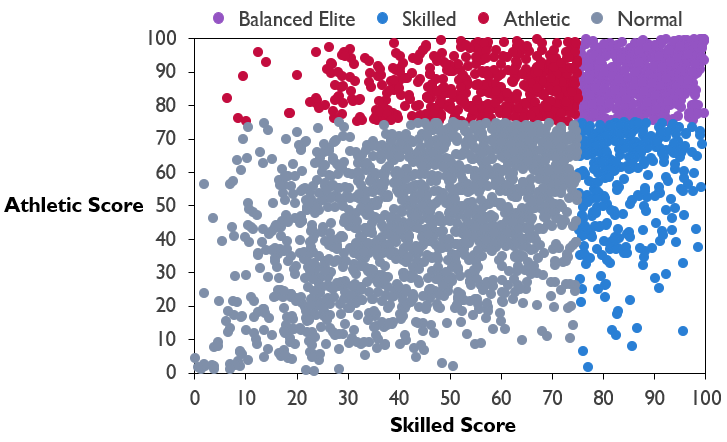
Figure: All players classified by athleticism and skilled scores – high attribute levels
The results indicate greater levels of post-peak playing time for highly skilled players than highly athletic players across all position groups, regardless of the athleticism and skill score thresholds being used in the analysis. Players who exhibit exceptional levels of both athleticism and skill age the best, while those with more average levels of both age the worst. In fact, the results are more stark when looking at elite-level players (considering players with only top-decile athleticism and skill levels) versus high-level players (top-quartile). The only exception of the overall conclusion comes at the fullback position, where athleticism appears to matter slightly more than skill – in line with well-known requirements of that position. These findings hold true when goals and assists are assessed for forward players, rather than playing time metrics.
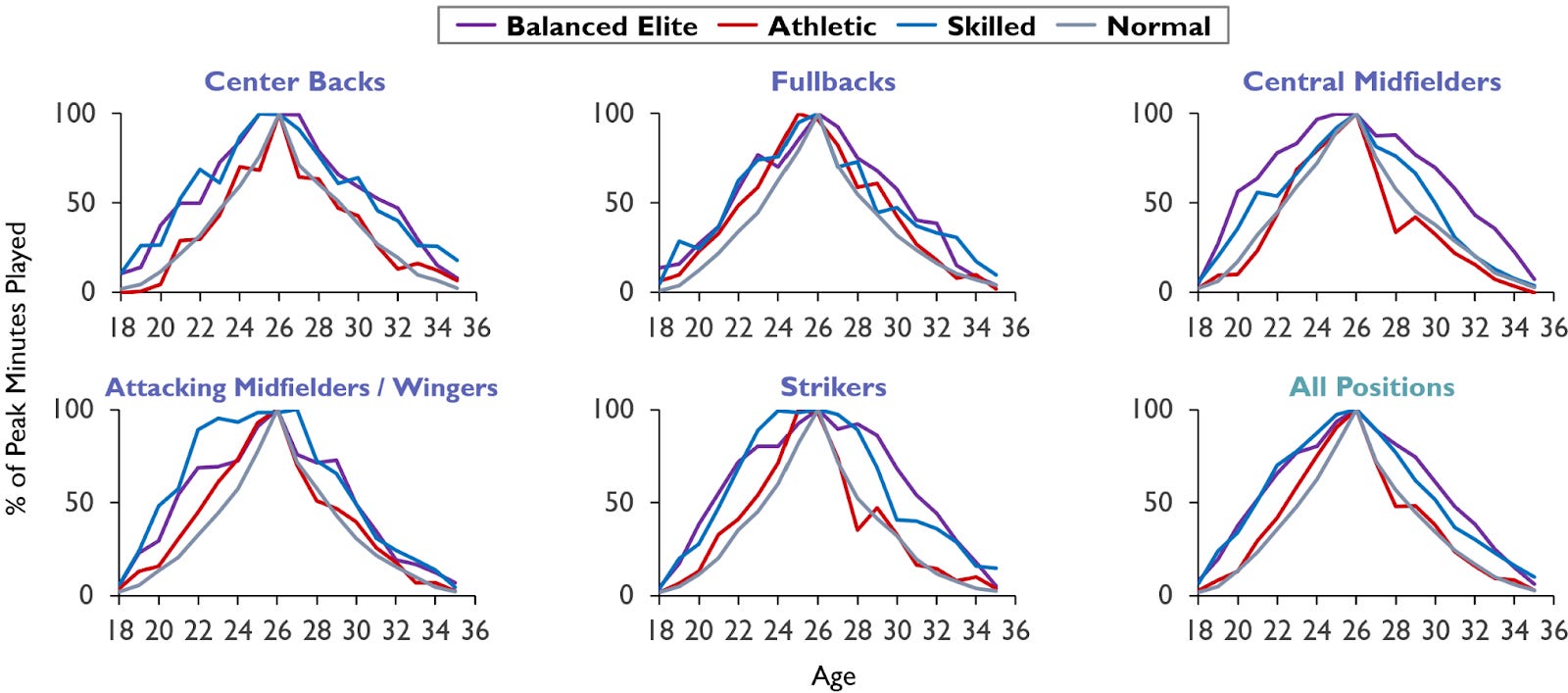
Figure: Age curves by position and classification group – elite attribute levels
Using a calculated metric called Post-Peak Minutes Index that quantifies a player group’s share of post-peak minutes relative to peak minutes, the results are quite consistent and significant across positions. Furthermore, the results indicate that athleticism offers minimal incremental value above being a normal player. This conclusion was also reached via a more granular analysis finding that contingent on being highly skilled, incremental levels of athleticism lead to no greater levels of post-peak playing time, whereas skill level matters considerably for highly athletic players. An additional key piece of analysis found that the relationship between a player’s skill level and his post-peak playing time (a correlation of 0.60) is far greater than his athleticism level with his post-peak playing time (0.22).
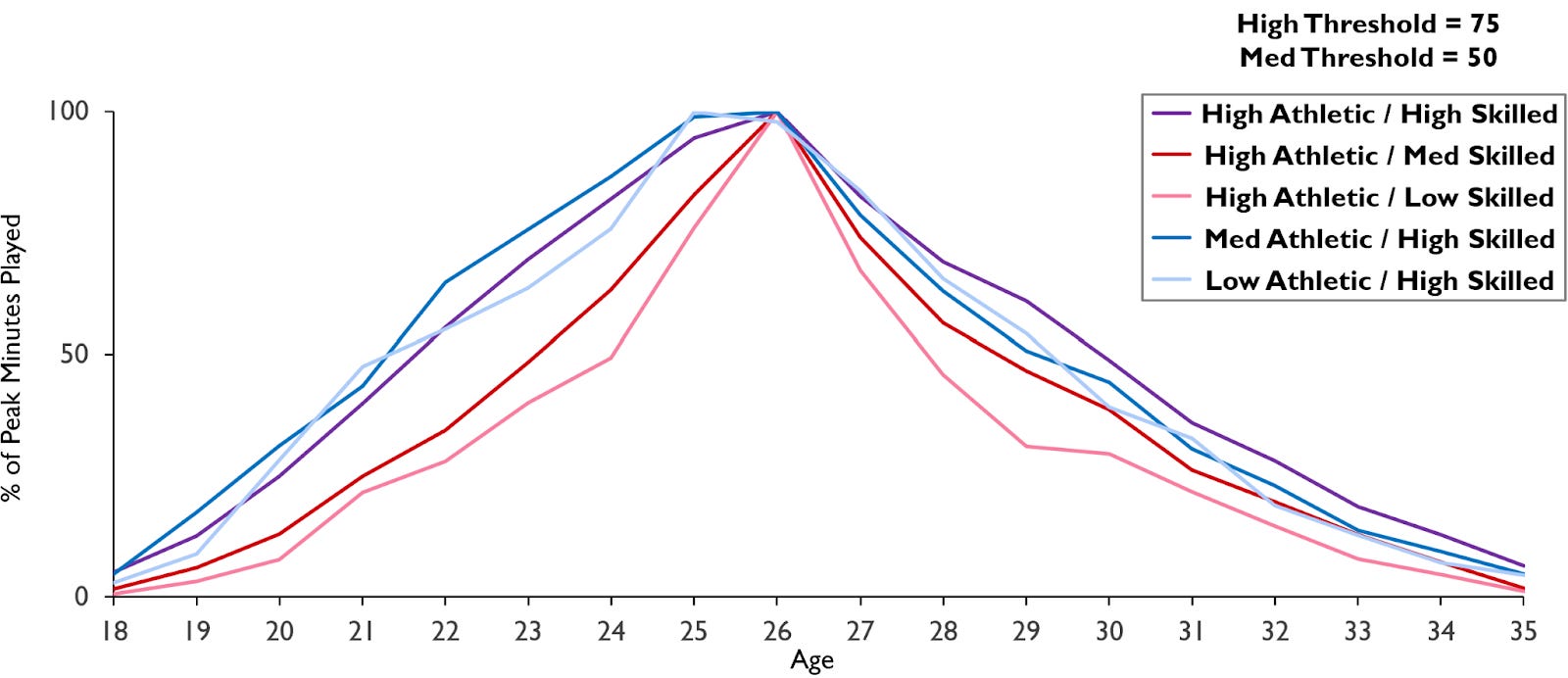
Figure: Age curves by granular classification group – all positions
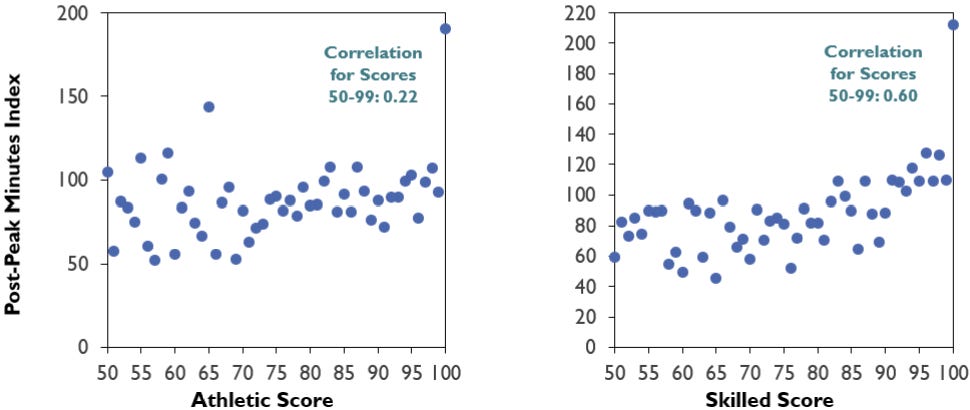
Figure: Relationships between Post-Peak Minutes Index and Athletic/Skilled scores
The study’s conclusion that highly skilled players age more effectively post-peak than highly athletic players builds on aging analysis in soccer and other sports, where researchers have generally found that athleticism levels peak by a player’s mid-20s and precipitously decline thereafter. The aging process forces a player to offset athleticism loss with skill and acumen improvements. As players who rely on their athleticism to provide value lose their athleticism in their mid- to late-20s, they cede their value proposition to younger players, whereas highly skilled players are able to maintain or perhaps even increase the value they provide until their athleticism drops below a necessary level to continue performing.
Clubs would benefit from using these insights to help guide player investment decisions. In particular, the study indicates that clubs should be more cautious investing in athleticism-dominant players and more comfortable investing in skill-dominant players beyond their peak years. Clubs and players should also consider how they can improve their players’ technical and mental skills to improve their longevity rather than relying on later-year athleticism, which of course must still be trained. Furthermore, the study verified research consensus that players peak between the ages of 25 and 27 – with center backs peaking slightly later and central midfielders peaking slightly earlier – earlier than many clubs seem to realize.
Current prominent players in the athleticism-dominant groups include Raheem Sterling, Milan Škriniar, Wilfried Zaha, Thomas Partey, and Marcel Sabitzer. As a collective, the study indicates we should expect that group to see steeper drop-offs than more skill-based players, which feature Jack Grealish, Marco Verratti, Thomas Lemar, Pierre-Emile Højbjerg, and Miguel Almirón. Of course, players with a balance of elite skills such as Joshua Kimmich, Virgil van Dijk, Bruno Fernandes, Ferland Mendy, and Leon Goretzka are most likely to have sustained post-peak careers. While taking the study to yield definitive conclusions about individual players would be foolish, the consistency and magnitude of the findings inspire confidence in the relative collective outcomes of these groups.
With tens of millions of dollars continuing to be spent each year on acquiring peak-age and post-peak-age players on the transfer market, clubs that can more effectively prioritize their player investment decisions stand to gain both on the pitch and off the pitch. This study points clubs toward a key finding that when assessing players that they will own beyond the players’ peak years, they should target skill-oriented players and be more wary of their athleticism-dominant counterparts.